
Why Is My Viking Oven Cooking Unevenly?
You pull the tray out expecting a batch of evenly golden cookies and instead find the back row nearly burnt while the front row still looks pale and underdone. Or maybe it's a roast that's perfectly done on one side and stubbornly pink on the other, despite sitting in the exact center of the oven the whole time. For an appliance with Viking's reputation, precision engineering, commercial-grade heating, the kind of performance serious cooks specifically pay a premium for, uneven results feel especially jarring, almost like the oven is betraying its own reputation.
The frustrating part is that uneven cooking rarely announces itself with an error code or an obvious warning sign, it just shows up quietly in the food itself, which makes it easy to blame your recipe or your technique before you ever consider the oven. In reality, there's almost always a specific, identifiable cause behind it, and most of them are worth ruling out before assuming anything is seriously wrong.
Check Your Rack Position and Pan Placement First
Before troubleshooting the oven itself, it's worth ruling out the simplest explanation. Ovens naturally have some airflow variation between the front, back, and sides of the cavity, and placement that made sense in a different oven doesn't always translate perfectly to a Viking's specific airflow pattern. Try centering pans more precisely and leaving more clearance between multiple trays, since overcrowding restricts the circulation the oven depends on for even heat distribution.
A Malfunctioning Convection Fan
Viking ovens with convection settings rely on a fan to circulate hot air evenly throughout the cavity. When that fan is weak, running inconsistently, or has failed outright, heat stops distributing the way the oven was designed to manage it, and you end up with exactly the kind of hot-spot, cold-spot pattern that shows up as unevenly baked food. Listen for the fan's normal hum during a convection-mode bake; silence or an unusual grinding sound points fairly directly to this as the cause.
Heating Elements Not Glowing Evenly
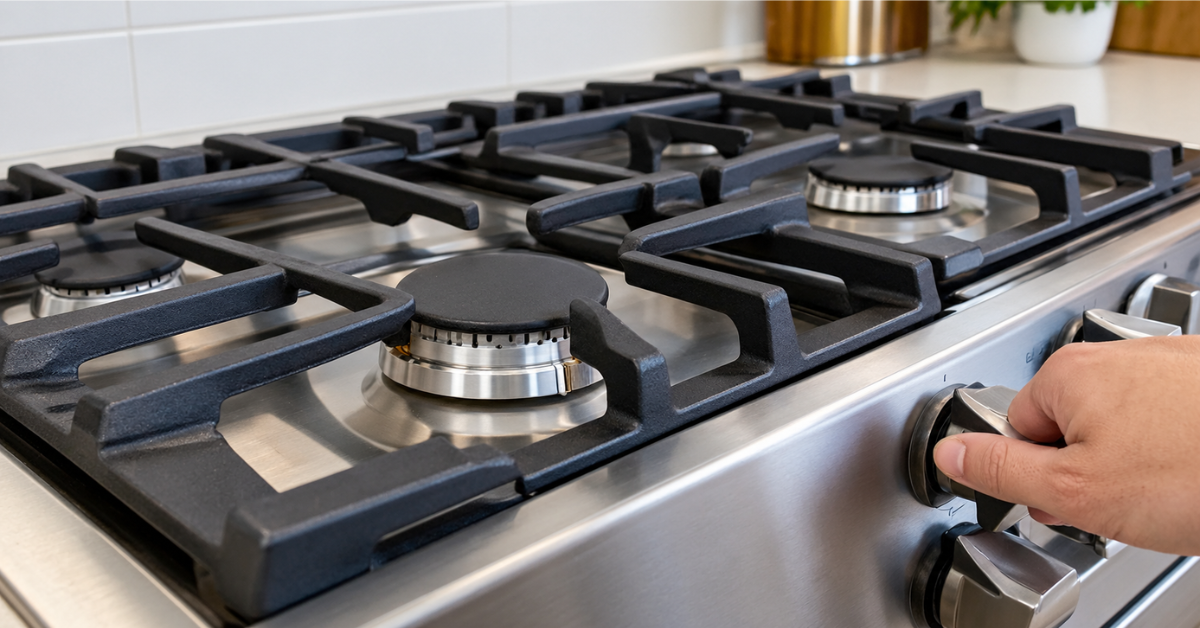
On electric ovens, look at the heating elements. There's a bake element on the bottom and a broil element at the top. When they're on, both should glow an even red-orange color from end to end. If one part of an element looks darker or dimmer than the rest, that part isn't heating. Sometimes you can also see damage, like a crack, a blister, or a broken spot. It may look like a small problem, but it isn't. Even one weak section can throw off the heat inside the whole oven. That's why food cooks unevenly, with one side done and the other side still pale. Many people are surprised by this. A tiny damaged spot can cause a much bigger cooking problem than you'd expect.
A Thermostat or Temperature Sensor That's Drifted Out of Calibration
Your oven can think it's holding the right temperature when it isn't. The display might say 350°F, but the inside could be running hotter or cooler than that. This usually happens with age. Ovens have a temperature sensor and a thermostat that tell the oven when to heat up and when to stop. After years of regular use, these parts can slowly drift out of calibration. They stop reading the heat correctly. The oven then makes the wrong decisions about when to turn the heat on and off. The result isn't always a clean, steady error, like an oven that's simply 25 degrees too hot. More often the temperature swings up and down during the cooking cycle. That's why you get uneven results: edges that burn, centers that stay raw, or food that takes longer than the recipe says. The oven isn't just off by one number. It has become less precise the whole time it's running.
Door Seal Issues Letting Heat Escape Unevenly
A gasket that's lost its seal in one specific section, rather than failing uniformly all the way around, allows heat to escape unevenly from that particular area. This creates a genuine temperature gradient inside the cavity, often most noticeable as food closest to the affected section of the door cooking slower than food elsewhere in the oven.
Hot Spots From Normal Wear and Design
Some degree of hot-spot variation is actually normal in most ovens, including high-end models, and isn't necessarily a sign of malfunction. Rotating pans halfway through baking is standard practice for a reason. The distinction worth paying attention to is whether the unevenness has gotten noticeably more pronounced recently, or whether it's always been present at roughly the same, manageable level, since a worsening pattern points toward an actual developing issue rather than the oven's baseline behavior.
A Detail Worth Knowing About Dual-Fuel and Multi-Zone Models
Viking's dual-fuel ranges and multi-zone ovens manage gas and electric heating elements somewhat independently, which means an issue affecting one heating zone specifically can produce more pronounced unevenness than you'd see in a simpler single-heat-source oven. If your model uses this kind of configuration, it's worth noting which zone or section of the oven seems most affected when describing the issue to a technician, since it meaningfully narrows the diagnosis.
A Practical Way to Narrow It Down at Home
- Rule out rack position and pan placement or spacing first
- Listen for the convection fan running normally during a convection bake
- Visually check that both heating elements glow evenly when active, if your model is electric
- Note whether the unevenness is new and worsening, or a longstanding, mild pattern
- Check the door seal for any visible gaps or looseness in a specific section
When It's Worth Calling a Technician
Fan replacement, heating element replacement, thermostat recalibration, and door seal adjustment all typically require accessing internal components that aren't designed for casual homeowner repair. A technician can also properly test actual internal temperature against the display using calibrated equipment, which is the only reliable way to confirm a calibration issue rather than guessing based on how food turns out.
Getting a Reliable Diagnosis
Viking's commercial-grade heating and convection systems benefit from technicians experienced specifically with premium cooking appliances. Authorized Appliance's technicians carry commonly needed oven parts, elements, fan motors, and thermostats among them, directly in their service vehicles, which typically keeps a Viking oven repair to a single visit.
Frequently Asked Questions
Q: Is some unevenness in oven baking actually normal?
A: Yes, minor hot spots exist in most ovens, and rotating pans halfway through baking is standard practice. What's worth investigating is unevenness that's noticeably worsened or is significant enough to consistently affect results.
Q: How can I tell if my Viking oven's convection fan has failed?
A: Listen for the fan's normal hum during a convection bake. Silence, or an unusual grinding or rattling sound, points toward a fan issue rather than normal operation.
Q: Can a calibration issue really cause uneven cooking, not just wrong temperature?
A: Yes, a thermostat or sensor that's drifted out of calibration can affect how precisely the oven holds temperature throughout the cooking cycle, which sometimes shows up as unevenness rather than a simple flat temperature offset.
Q: Do I need a technician to recalibrate my Viking oven's temperature?
A: Recalibration typically requires proper testing equipment to confirm actual internal temperature against the display, which makes it a task better suited to a professional than a DIY attempt.
A Final Note
Uneven cooking in a Viking oven usually comes down to one of a handful of identifiable causes, airflow, a fan, an element, or calibration, rather than something wrong with your technique. Starting with the simplest checks, rack position and listening for the fan, before assuming a bigger repair is needed gives you a real chance at narrowing it down yourself before ever picking up the phone.
You might also like
Educational Center