
Oven Not Heating Evenly? Common Causes and Fixes
If you've ever pulled out a tray of cookies that's golden brown on one side and still pale on the other, or carved into a roast that's somehow still pink after sitting well past its cook time, you already know how frustrating an oven that heats unevenly can be. It's one of the most common oven complaints, and the good news is that it usually traces back to a short, predictable list of causes — most of which you can check yourself before deciding whether it's a DIY fix or a job for a technician.
Start With the Bread Test
Before troubleshooting any specific part, it helps to know exactly where your oven is running hot or cold.
Preheat the oven to 350°F, then lay slices of bread across a full rack. Let them sit for about 5 minutes, then check the color. Darker, more toasted spots show where the oven runs hot; pale or barely toasted areas show where it runs cool.
This quick test tells you a lot upfront. If the unevenness is isolated to one area, the cause is more likely airflow, rack position, or a single failing heating element. If the whole oven seems to run either too hot or too cold overall, you're more likely dealing with a sensor or calibration issue instead.
A Failing Heating Element Is the Most Common Cause
In electric ovens, the bake element at the bottom and the broil element at the top work together to heat the cavity evenly. When one of them burns out, the other has to compensate on its own, which throws off the balance — often leaving food undercooked on the bottom or over-browned on top.
You can check this yourself by running the oven for a few minutes and carefully looking through the door window. A properly working element glows a steady, bright red. If it glows dim, flickers unevenly, or doesn't glow at all, or if you notice visible blisters, holes, or breaks along the coil, that element has likely failed. Once a heating element burns out, it can't be repaired — it needs to be replaced with a new one.
Gas Ovens Have Their Own Common Culprits
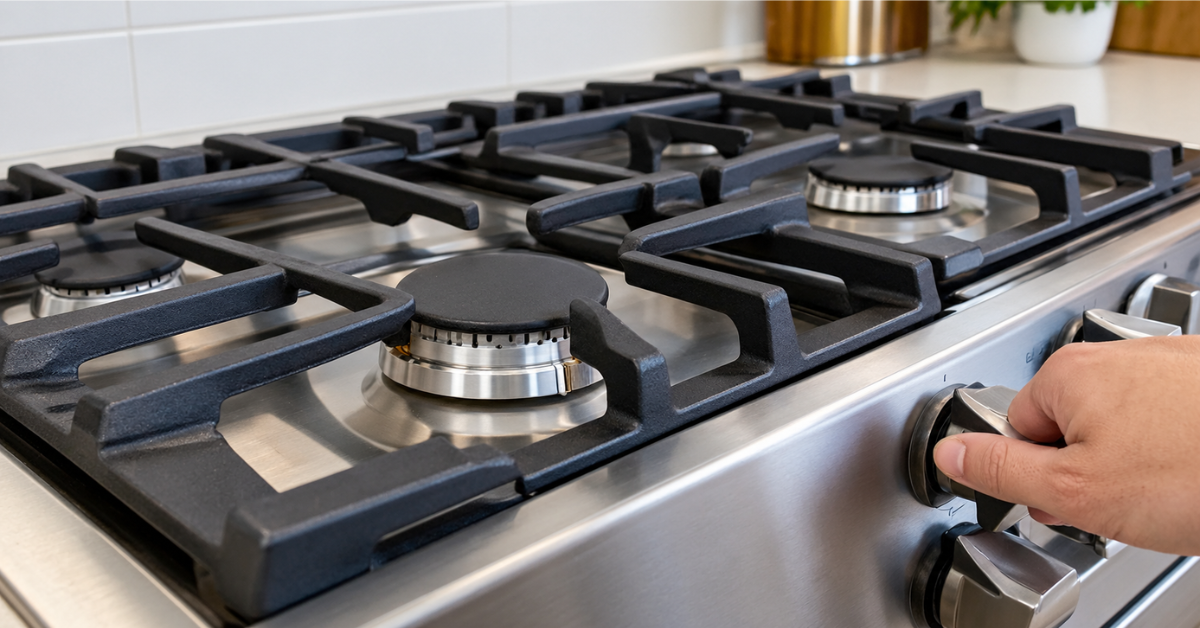
If you have a gas oven, the equivalent issue is usually the burner tube or the igniter rather than a heating element.
A burner tube that's deteriorated, or whose holes have become clogged or misshapen, won't distribute the flame evenly across the cavity, which creates the same kind of hot-and-cold-spot pattern you'd see with a failed electric element. A weak or failing igniter can cause similar symptoms, along with slow or inconsistent preheating.
Both of these involve gas supply components, so they're best left to a technician to inspect and replace safely rather than something to test on your own.
Is It Worth Repairing an Appliance Under Warranty? What to Know
Your Temperature Sensor Might Be Out of Position
If the whole oven seems to run consistently too hot, too cold, or cycles in an unpredictable way, the temperature sensor is worth checking next.
This is a thin metal probe, usually mounted near the top interior of the oven, that reports the actual internal temperature back to the control board. If it gets bumped out of its proper position — even slightly — or touches the oven wall, the readings it sends become inaccurate, and the control board ends up regulating heat based on the wrong information.
Check that the sensor is sitting straight and isn't in contact with the wall of the oven. If it's shifted, gently move it back into place. If uneven heating continues after that, the sensor itself may be failing internally and need to be tested or replaced.
Calibration Drift Is Easy to Overlook
It's common to assume a part has failed when really, the oven has simply drifted out of calibration over time. This means the temperature you set on the dial or panel isn't actually the temperature inside the cavity — and unlike a failed element, this tends to affect the whole oven fairly evenly rather than creating isolated hot and cold spots.
You can check this with an oven-safe thermometer. Set the oven to 350°F, and once it signals that it's preheated, compare the thermometer's reading to your set temperature. A difference of more than about 25°F usually points to a calibration issue, which can often be corrected through the oven's control panel settings — your model's manual will have the exact steps.
Overcrowded Racks and Foil Restrict Airflow
Even a perfectly functioning oven needs room for hot air to circulate. Overcrowded racks, oversized pans, or foil lining the oven floor or racks can all block that circulation and create uneven results, no matter how well the oven's internal components are working.
Leaving at least 2 inches of space between baking dishes, avoiding foil on the racks or oven floor, and keeping the door closed during baking (every time it's opened, heat escapes and the oven has to work to recover) all go a long way toward fixing airflow-related unevenness without needing a repair at all.
A Broken Convection Fan Undermines Even Cooking
If your oven has a convection setting and you're still seeing inconsistent results, the fan itself may be the problem. The convection fan is what actively pushes hot air throughout the cavity for more even heat distribution. If the fan motor fails or the blades become obstructed, that circulation stops, and the oven effectively behaves like a standard oven with hot and cold spots — even though the convection setting is turned on.
A technician can test whether the fan motor is receiving power and spinning freely, and replace it if it's failed.
How Much Does Appliance Repair Cost in 2026? (By Appliance Type)
Grease and Buildup Can Interfere Too
Baked-on grease and food debris inside the oven cavity can interfere with heat distribution, and in some cases, buildup near the temperature sensor can throw off its accuracy as well. A thorough interior cleaning, using mild oven-safe cleaners rather than harsh chemicals, is worth doing before assuming a mechanical part has failed — it's a simple step that occasionally resolves the issue on its own.
When It's Time to Call a Technician
If you've checked rack spacing, ruled out foil blocking airflow, confirmed the oven is reasonably clean, and hot and cold spots or inaccurate temperatures are still showing up, you're most likely dealing with a failed heating element, igniter, temperature sensor, or convection fan motor. These all require professional testing and OEM replacement parts to repair correctly and safely — guesswork here can lead to buying and installing the wrong part.
At Authorized Appliance, we connect you with factory-authorized technicians for major oven and range brands, including Whirlpool, Samsung, LG, Maytag, KitchenAid, and GE. Our technicians pinpoint exactly which component is causing the uneven heating and repair it using manufacturer-approved parts, so the fix actually holds.
Call (833) 220-1666 or contact us online to schedule a diagnostic and get consistent, even baking back in your kitchen.
You might also like
Educational Center